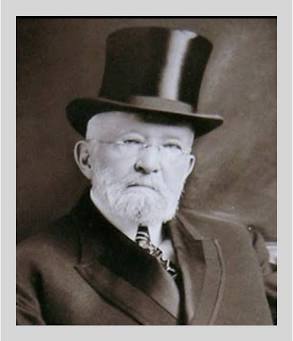
If Dr James C. Crow gave American whiskey a method, Colonel Edmund Haynes Taylor Jr. gave it a definition enforceable in court. Born in 1830, orphaned young and adopted by Edmund Haynes Taylor Sr., he was raised in part by his great-uncle Zachary Taylor, later the twelfth President. He came to whiskey from banking, and it shows: his lasting contribution is regulatory.
The rectifier problem
By the late 19th century a large share of what Americans drank as aged whiskey had never been near a barrel. Rectifiers bought cheap, unaged neutral spirit and dressed it to look and taste like bourbon. The documented additives are genuinely alarming — iodine, tobacco, prune and cherry juice, burnt sugar, turpentine, creosote, cochineal, and in some accounts sulfuric acid.
For a producer of real aged whiskey this was worse than unfair competition: it was reputational poison for the whole of Kentucky. Taylor's response was to make the distinction a matter of federal law rather than of trust.
The Bottled-in-Bond Act of 1897
Taylor led the distillers' campaign and found his ally in John G. Carlisle, then Secretary of the Treasury. The resulting Act let a whiskey carry a government tax stamp only if it met strict conditions:
- The product of one distiller at one distillery.
- The product of a single distillation season — legally January to June, or July to December, which the trade still calls spring and fall.
- Aged at least four years in a federally bonded warehouse under government supervision.
- Bottled at exactly 100 proof (50% ABV).
- Labelled with the distillery of production and the place of bottling.
The green stamp that sealed the cork carried Carlisle's own likeness. The government's motive was not purely consumer welfare — bonding let distillers defer excise tax until the spirit came out of the warehouse, and supervision protected the eventual collection of it — but the effect was a guarantee a drinker could rely on. It is widely described as one of the first federal consumer-protection measures in the United States, arriving nine years before the Pure Food and Drug Act of 1906.
The distiller James E. Pepper is sometimes named as a co-campaigner. That claim traces mainly to the revived brand that bears his name, and the standard accounts of the Act credit Taylor and Carlisle.
The distillery
Taylor also rebuilt how a distillery worked. At his O.F.C. — Old Fire Copper — plant he installed copper fermentation vessels in place of wood, modernised grain handling, and built climate-controlled warehouses heated by steam so that maturation continued through a Kentucky winter instead of stalling. That site became the George T. Stagg Distillery and is today Buffalo Trace, which still bottles a range under his name.