No distillery is more widely recognised, or more widely misunderstood, than the one in Lynchburg, Tennessee. Jack Daniel’s is the best-selling American whiskey in the world, and every drop of it is still made in one hollow in Moore County — a dry county where you cannot legally buy a drink in a bar.
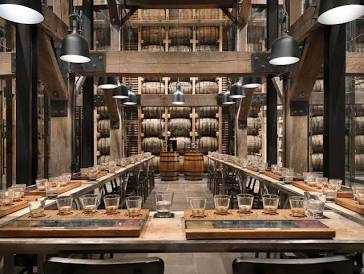
The Call Farm and Nathan "Nearest" Green
Jasper Newton "Jack" Daniel left home young and was taken in by Reverend Dan Call, a lay preacher, farmer and moonshiner. But the man who actually taught him to distil was Nathan "Nearest" Green, an enslaved man who ran Call’s still and served as its master distiller.
When Daniel set up his own legitimate operation after the Civil War, he hired Green as his first Master Distiller — making Nearest Green the first known African American master distiller in the United States. For most of a century his role was left out of the story the brand told about itself. It has since been restored, and it belongs at the front of any honest account of this distillery: the charcoal-mellowing craft that defines Jack Daniel’s came from Green.
Registration and Cave Spring Hollow
Call left distilling over religious objections and Daniel took over, registering the business with the federal government in 1866 — the basis for its billing as the first registered distillery in the United States, a claim that is the distillery’s own and that some historians place nearer 1875.
Daniel soon moved production beside Cave Spring Hollow, whose limestone spring runs at a constant 56°F and carries no iron. That matters chemically rather than romantically: iron blackens whiskey and ruins its flavour. In 1904, Old No. 7 took a gold medal at the St. Louis World’s Fair.
Lem Motlow and thirty years of closure
Daniel never married and had no children. In 1907, in failing health, he left the distillery to his nephew Lem Motlow, who inherited a business about to be legislated out of existence. (The story that Daniel died after kicking his office safe is repeated everywhere — treat it as folklore rather than medical record.)
Tennessee went dry in 1910. Motlow tried distilling in St. Louis and Birmingham, but the whiskey was not the same and was never sold. National Prohibition closed the operation entirely in 1920, and Tennessee kept its own ban even after repeal in 1933. Motlow, by then a state senator, won the right to distil again in Moore County only in 1938 — a closure of nearly three decades. Brown-Forman bought the distillery in 1956 and still owns it, leaving the production method alone while turning a regional whiskey into a global one.
What makes it Tennessee Whiskey
Tennessee Whiskey must meet every requirement of bourbon and then two more: it must be made in Tennessee, and it must be charcoal-mellowed before it ever touches a barrel.
The mash bill is 80% corn, 12% malted barley and 8% rye — corn for sweetness, rye for pepper, malted barley for the enzymes that convert the rest into fermentable sugar. The distillery runs a sour mash, returning spent mash from the previous run to hold the pH steady so its proprietary yeast behaves identically every time. Fermented beer of roughly 10% ABV goes into copper column stills and comes off at 140 proof as clear, unaged spirit.
The Lincoln County Process
This is the step that separates the distillery from every Kentucky bourbon. Before barrelling, the clear spirit is dripped through ten feet of tightly packed sugar maple charcoal, burned on site from ricks of maple wood. The spirit takes three to five days to work its way down under gravity alone.
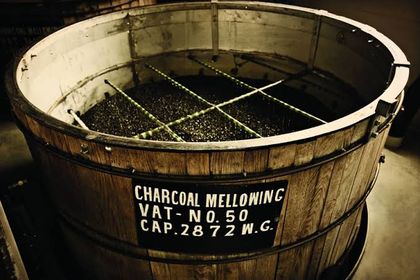
The process is subtractive. It strips out harsh congeners and fusel oils rather than adding anything, leaving a softer spirit carrying a faint sweet smokiness. It costs time and it costs yield, and the distillery has never abandoned it.
Barrels
Brown-Forman is one of very few whiskey companies to own its cooperages, so the distillery controls its own barrel-making. Barrels rest in multi-storey barrelhouses across the Lynchburg hills, where position decides everything — the upper floors swing hardest between hot and cold and mature fastest. The core range carries no age statement; whiskey is drawn when the tasting panel judges it ready, usually between four and seven years.
Eight master distillers in 150 years
Continuity is the point. Nearest Green came first, then Jack Daniel himself; Jess Motlow carried the yeast strain and the recipes through Prohibition; Lem Tolley, Jess Gamble and Frank Bobo took it from post-war shortages to a global brand. Jimmy Bedford added Gentleman Jack and Single Barrel Select, the first new expressions in a generation, and Jeff Arnett brought Tennessee Rye and No. 27 Gold. Chris Fletcher — Bobo’s grandson — has taken the distillery into aged, premium territory since 2020.
The range
- Old No. 7, 80 proof — the flagship. Banana, vanilla, toasted nut, caramel.
- Gentleman Jack, 80 proof — charcoal-mellowed twice, before and after the barrel. Lighter, rounder.
- Single Barrel Select, 94 proof — upper-floor barrels, where the temperature swings pull deeper oak and spice.
- Single Barrel Barrel Proof, 125–140 proof — uncut and unfiltered.
- Tennessee Rye, 90 proof — a 70% rye mash bill, still charcoal-mellowed.
- Bottled-in-Bond, 100 proof — one season, four years minimum, a bonded warehouse.
- 10, 12 and 14 Year — the oldest whiskey released here in a century.
- Sinatra Select, 90 proof — barrels with grooves cut into the staves to expose more toasted wood.
- Coy Hill — the highest proof it has ever bottled.
Sinatra, rock and roll, and a dry county
Frank Sinatra was handed a glass by Jackie Gleason in 1947 and spent the rest of his life advertising it for nothing — calling it the nectar of the gods, drinking it on stage, and being buried with a bottle. The square bottle and the black label then attached themselves to the Rolling Stones, Led Zeppelin and most of the Sunset Strip, and never came off.
Lynchburg has hosted the Jack Daniel’s World Championship Invitational Barbecue since 1989. The distillery ships more than 16 million cases a year out of a town where you still cannot buy a drink, and where the only bottle for sale is a commemorative one at the visitor centre itself.